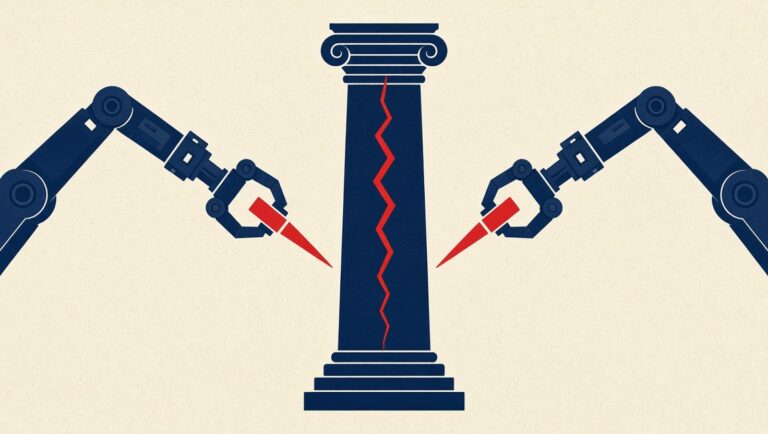
Mistral Gives Away a Trillion-Parameter AI as Google Locks Its Own Up
Mistral has released the weights of Large 4, a 1-trillion-parameter model anyone can download, as Google keeps its top cyber model for vetted defenders. What that means, and who can really use it.


The number is one trillion. That is how many parameters, the internal settings an AI learns during training, sit inside Mistral Large 4, the model the French company made free to download on 29 October. In the same week Google said its strongest model for cyber security would go only to vetted defenders at first. Two of the best-funded ideas in AI are now pulling in opposite directions, and the gap between them matters to anyone who uses, buys or worries about AI.
What Mistral released
Mistral first showed Large 4, nicknamed “Le Chonk”, as a paid preview on 6 October and promised the weights by the end of the month. It has now published them. The weights are the trained model itself, the file that turns a question into an answer. Releasing them means anyone with enough computers can run the model on their own machines instead of renting it through Mistral’s website.
The model card on Hugging Face gives the scale. Large 4 has about 1 trillion parameters in total but uses only around 52 billion of them for each word it writes. That design, called a mixture of experts, splits the model into specialist parts and wakes only a few at a time. It keeps the running cost far lower than the headline size suggests. The model reads text and images, can hold about 1 million tokens (roughly 750,000 words) in view at once, and Mistral says it is fluent in more than 160 languages. It was trained from scratch on 3,800 Nvidia Grace Blackwell chips in Mistral’s own data centres in Europe.
Mistral also lowered its price. Using the model through its own service now costs $0.70 per million tokens of input and $2.10 per million tokens of output. A token is a chunk of text, about three-quarters of a word.
How good is it
On Mistral’s own reading of the benchmarks, it is the best open model for coding. On the Artificial Analysis Coding Agent Index, an independent test of AI coding assistants, it scores 48%. That is effectively level with GLM-5.3, a Chinese open model, while using 47% fewer tokens per task, Mistral says. Fewer tokens means a cheaper bill for the same work. On Terminal-Bench 4.0, a test of working inside a computer’s command line, it rose 13 percentage points to 41% in the three weeks since the preview.
The overall picture is more modest. On the broader Artificial Analysis Intelligence Index, Large 4 scores 26, according to its model card. Mistral says that is the highest of any Western open model, and admits that the leading Chinese open models score higher. Google’s new Gemini 4 Carbon scores 59 on the same index, the top mark. In plain terms, the free European model is strong for a model you can own, but it is not close to the best closed models on general ability.
The cyber security bet
The sharpest difference this week is about cyber security. Mistral pitches Large 4 as a tool for defenders, the people who find and fix holes in software before criminals do. It scores 51% on the Artificial Analysis Cyber Index, which tests whether a model can find a flaw in code, prove it is real and patch it without breaking anything. Mistral says the model also refused 96.6% of malicious cyber requests in standard safety tests, the highest rate it measured among open models.
Pierre Stock, Mistral’s vice-president of science, explained the thinking to TechCrunch. Governments and companies, he said, get “access to frontier intelligence to defend yourselves against cyberattacks. Access that can’t be cut off by definition because the model is open-weighted.”
Google took the opposite route with Gemini 4 Carbon, announced on 28 October. It calls Carbon its strongest model, with state-of-the-art results at finding, exploiting and patching software flaws. Rather than release it widely, Google is giving it first to a small group of cyber defenders, then to more trusted partners through a vetted access scheme. Developers and the public come later, once Google has tested its guardrails. Anthropic has been similarly cautious with an unreleased Claude model that broke into Chrome, Safari and Linux in tests.
Want AI to save you hours a week? Our free playbook shows you how.Get the free guide →The worry behind that caution is simple. A model that is good at finding holes can be used to attack as well as defend. Mistral does not dodge this. In its release post it says it watched how people used the preview and, although the model refused to attack live targets, it saw “a potential for uplift to conduct real attacks”. It says it is changing its guardrails in response. A more capable cyber version of Large 4 is going only to vetted partners, such as Orange Cyberdefense, under contract.
Here is the catch with open weights. Guardrails on Mistral’s own website can be updated at any time. Guardrails built into a downloaded model are fixed once the file leaves the building, and a determined user can try to train them away. Mistral is betting that giving defenders the tool sooner is worth more than the risk of attackers using it too.
Who can actually run it
“Free to download” does not mean anyone can use it at home. Mistral’s own setup guide on the model card runs the model across eight high-end graphics chips working together. For a sense of scale, Meta’s slightly smaller open model, Muse Spark Open, needs about 537GB of storage just for its compressed weights, Meta says, before the extra memory needed to run it. That is far beyond a laptop or a gaming PC.
So the real customers are banks, governments, telecoms firms and large companies. Mistral’s launch post quotes La Banque Postale, ABN AMRO, Belfius and the European Space Agency’s Φ-lab among the organisations backing the model. For them the appeal is control. Their data stays on their own servers, and no supplier abroad can switch the model off or change it overnight. Europeans call this sovereign AI.
There is one string attached. The licence is a modified version of the MIT licence, a common free-software licence. Anyone can use, change and sell products built on the model, but a business that resells access to it as an online service needs a separate commercial licence from Mistral. That stops a rival cloud company simply hosting Mistral’s work and undercutting it.
What it means for ordinary users
Most people will never download Large 4. They may still meet it. If a bank, a government office or an app maker builds on an open model they host themselves, your data may never leave that organisation’s servers. That is a genuine privacy difference from sending every question to a US or Chinese company.
Open models also put a ceiling on prices. When a capable model is available to run for the cost of the hardware, closed providers find it harder to charge much more for similar work. Carbon will cost $2 per million input tokens and $10 per million output tokens at its introductory price, Google says, rising to $4 and $20 later. Large 4 is far cheaper, though it also does less.
And the open race is now global. The strongest open models have mostly come from China, where labs have also faced claims that they trained on output from US models. Mistral’s release gives Europe a credible entry, and Meta’s Muse Spark Open, released in mid-October, gives the US one.
What to watch
Three things will show whether Mistral’s bet pays off. The first is the full technical report it has promised, which should let outsiders check its benchmark claims. The second is any sign that criminals use Large 4 in real attacks, which would strengthen the case for Google’s slower approach. The third is adoption. If European banks and governments move real work onto a model they host themselves, open weights stop being a principle and become a business.